
Transcript
[Visual: Title slide displayed with the heading "Step Four: Identifying Risk Mitigation Strategies".]
Kelly: Welcome back to the Adapting to Change workshop. Let's move on to step four, identifying risk mitigation strategies.
The strategy you choose to employ to mitigate risks will depend on a range of factors, including the size of risk, your risk appetite, your budget, and ease of implementation.
Risk mitigation strategies: Internal processes and checks
[Visual: Slide titled "Risk Mitigation Strategies: Internal Processes & Checks" appears. The slide asks: • What processes and checks could you put in place to minimise the likelihood of a certain event occurring? • Ensure the business could continue if the event did occur? • What plan could you build to minimise the resultant damage?]
Kelly: In the first instance, we want to consider how you could mitigate these risks internally. What processes and checks could you put in place to minimize the likelihood of the event occurring? Ensure the business could continue even if the event did occur.
What plan could you put in place to minimize the resultant damage?
Don't worry, we are going to cover all of this in this part of the workshop.
Example: Local retail and online clothing business
[Visual: Slide shows a risk mitigation strategy example for a local retail and online clothing business. A two-column layout displays risks alongside possible mitigation strategies.]
Kelly: Kicking off with some examples to help our thinking. If we go back to our local and online clothing business, one of the risks that they identified was one staff member manages all of the online orders.
Well, as a mitigation strategy, could we cross-train another staff member? Could we create simple documented procedures that even a casual could pick up and run with?
If we have limited cash reserves, could we regularly review cash flow forecast and operating costs? Could we build in an emergency reserve fund?
Could we also identify non-essential expenses that could be reduced?
If we look at the final risk identified for this business, consumer spending declines. Well, there's a heap of options here. Things like lowering-cost product options, different promotions, bundled offers. We see a lot of this out there in the market.
Or one of my personal favorites that keeps me coming back as a consumer to certain online stores are those that focus marketing on customer value and retention, membership programs. Those that give away discounts or store credit for repeat purchases.
Another risk we hear quite often is if a big client doesn't pay. What are some of the things that we could do?
Well, we could conduct background checks. Could we get them to pay a deposit before work commencing? Could we also adapt our business model to reduce risk? For example, a product isn't shipped until it is paid for. That's a pretty obvious one. But what about staged invoicing?
Can we also have an emergency fund to ensure business continuity if one large client does not pay us on time?
Exercise 12: Identify internal mitigation strategies
[Visual: Exercise slide appears with the prompt: "What are some potential internal mitigation strategies you could employ for your own business?"]
Kelly: Now, it's time to think about you and your business. What are some potential internal mitigation strategies you could employ for your own business?
Now, if you have a look in your workbook, see some additional examples to help your thinking.
Pause this video now to complete the exercise and we will see you back here soon.
Business continuity planning
[Visual: Slide titled "Business Continuity Planning". The slide asks: "If disruption occurred tomorrow, what would your business need immediately?" Listed items include key systems, customer communication, supplier access, financial access, staff responsibilities, and operational priorities. A statement at the bottom reads: "Businesses recover faster when key information, processes, and responsibilities are prepared in advance."]
Kelly: Welcome back.
Now you've had the opportunity to identify some risk mitigation strategies to try and reduce risk. Let's look at business continuity planning.
So, we've done our best to mitigate the risks and reduce them. They happen anyway. If disruption occurred tomorrow, we want to think about what our business would need immediately.
These could be key systems, customer communication, supplier access, financial access, staff responsibilities, and operational priorities.
Remember that this is about recovering faster. We can do so when we have key information, processes, and responsibilities prepared in advance.
A key thing to think about here, if disruption did happen, what is the plan that you can pick up and implement straight away and you don't need to spend time trying to figure it out in the process?
Business continuity planning examples
[Visual: Slide titled "Business Continuity Planning". A table pairs events or risks with possible business continuity plans:
- Flood event preventing staff from getting to work.
- Vital equipment breakdown.
- Marketing campaign receiving public backlash.
The slide provides example responses for each scenario.]
Kelly: Let's have a look at some examples now.
So, in the event a flood occurs and multiple staff members can't get to work, what are some of the business continuity plans that we could put in place?
We could have a list of casual staff or contractors, people you know that you could call at short notice. Or could your team work from home?
Another example, a vital piece of equipment breaks down. Can you create a list of service providers, maintenance support that you can call to fix urgent issues?
Now, I will just say here, it's not just about having the list. It's also about having a relationship with these suppliers. What relationships do you need to put into place now? So if things did go wrong, you can pick up the phone and get the service you need.
This is another common one we see out there in the market. A marketing campaign receives public backlash.
Well, could you have a public relations contact that you can call for advice?
Now, it might not be just a marketing campaign that receives public backlash. It could be a customer publicly reviewing your business. We see this quite often at the moment on LinkedIn.
You will notice that those businesses that have a plan in place to deal with public complaints actually further strengthen the relationship with their customers versus those who act reactively or don't reply at all.
Exercise 13: Business continuity planning
[Visual: Exercise slide appears asking: "What are some potential internal business continuity plans you could put in place?"]
Kelly: Now, let's think about your individual business. What are some of the potential internal business continuity plans you could put in place for the risks you have identified?
Pause this video now. We'll see you back here soon.
Enabling business continuity
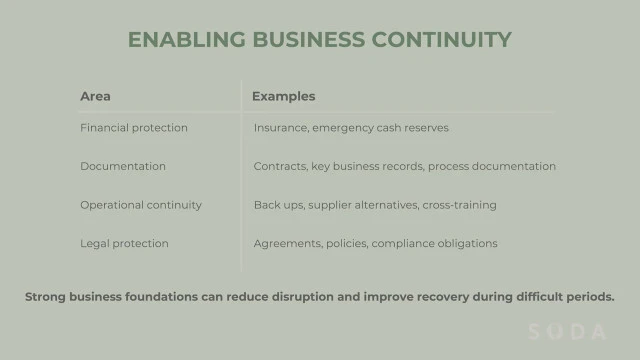
[Visual: Slide titled "Enabling Business Continuity". Text states: "Strong business foundations can reduce disruption and improve recovery during difficult periods." A central graphic illustrates business continuity foundations.]
Kelly: Welcome back. Hopefully that's given you an opportunity to identify some of the business continuity plans that you can put in place to help your thinking.
Here's some further examples.
If we're looking at financial protection, can you have insurance, emergency cash reserves?
In terms of documentation, if that's key risk, think about contracts, key business records, or process documentation that is down on paper.
In terms of operational continuity, can you have backups? Supplier alternatives that we touched on earlier.
Make sure you have a relationship with these. So when you pick up the phone, you're not waiting in line.
In terms of legal protection, agreements, policies, and compliance obligations.
Now, if you have a look in the back of your workbooks, you will see some extra resources that cover off insurance and legal elements.
These make up a fundamental area of your risk mitigation and continuity planning.
So I highly recommend that you check these out and remember it's all about building strong business foundations to reduce disruption and improve recovery during difficult periods.
Review risks regularly
[Visual: Final slide titled "Review Risks Regularly". The slide states that business risks and operating conditions change over time. Listed benefits of reviewing risks regularly include: • Identify problems earlier • Adapt faster • Improve preparedness • Respond more confidently
The slide also states: "Risk management is not a one-off activity. It should become part of regular business thinking."]
Kelly: This brings us to the end of business continuity and risk mitigation strategies.
Remember it is really important to review these risks regularly. We know the business environment changes rapidly over time and regularly reviewing these risks can help your business identify problems earlier, adapt faster, improve preparedness, and respond more confidently.
Remember, it's about picking up the plan you already have in place when things go wrong, not waiting for things to go wrong and then making a plan.
Risk management is not a one-off activity. It should become a part of your regular business thinking.
So ask yourself, how will you build this into your business moving forward?
This brings us to the end of part two of the workshop.
Join us back here soon for our final video, reflection and next steps.