
Transcript
Speaker: Kelly
[Opening slide displayed: Understand Where Your Core Business Value Lies. On-screen text: “To identify good pivot opportunities, you first need to understand what your business is truly valuable for.” Label: “Step Four”.]
Welcome back to the Adapting to Change workshop. Let's move on to step four.
Step four is all about understanding where your core business value lies.
So far, we've looked at external changes in the market. We're now going to put a pause on that and focus on your business. Because to identify potential pivots, we want to understand how the external problems you have already identified marry up with the core competencies of your business.
We want to undertake a critical and objective review of your individual business. We want to determine the most valuable business assets or anchors you have.
Understanding these will help us identify which parts of the businesses that you could leverage and which parts you could scale back or let go of.
Business anchors
[Slide displayed: What Are Your Business ‘Anchors’? On-screen text: “Sometimes what we think is the most valuable isn’t actually what customers care about.” An illustration shows a person considering different business priorities.]
Now, when identifying your business anchors, it's important to understand that these can be tangible assets or intangible assets.
Tangible, for example, equipment, product, premises, technology, inventory, or vehicles.
Intangible is more things money can't buy, like your brand reputation, customer loyalty, team knowledge, relationships, processes, and systems you've built up over time or community trust.
It's also worth noting that sometimes what we think is the most valuable thing isn't actually what customers care about.
Common business blind spots
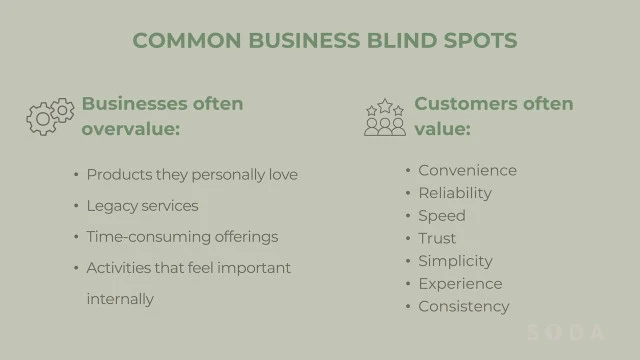
[Slide displayed: Common Business Blind Spots. On-screen text lists items businesses often overvalue: products they personally love, legacy services, time-consuming offerings, and activities that feel important internally. A second list shows what customers often value: convenience, reliability, speed, trust, simplicity, experience, and consistency.]
Some very common business blind spots we see out there is that businesses often overvalue things that customers may not value as much.
I know I've been in this boat before. Releasing products to the market that I love, customers maybe not so much.
Things like legacy services. It's worked this way for X amount of time. Why do we need to change?
Time-consuming offerings. How long is it taking you to put that piece out into the market?
Or activities that feel important internally. Is that actually providing value out there for your customers?
And what we then see, or more often see, is what customers really value are the basics. Convenience, reliability, speed, trust, simplicity, experience, and consistency.
Business model canvas
[Slide displayed: Business Model Canvas. The canvas includes sections for Problem, Solution, Unique Value Proposition, Customer Segments, Advantage, Existing Alternatives, Partners, Channels, Revenue Streams, and Cost Structure. Additional on-screen text explains that the Business Model Canvas can help businesses understand how they currently operate, identify strengths and weaknesses, challenge assumptions, spot areas that no longer align, and identify opportunities for change.]
So, to help identify some of these potential blind spots, we now want to look at our business.
And we're going to create something called a business model canvas.
You may or may not have seen this before, but this is a really great one-pager, a business on a page, so to speak, that really challenges you to think about the problem.
So, what is the problem that your customers are facing?
What is the problem that your business or solution is trying to solve?
In terms of solution, it's how you solve this problem currently and thinking about the current state of your business now, not how you will solve something in the future.
Your unique value proposition. So, what's unique about your solution? This is what we want to start testing.
There's a lot more that you can fill out in here. For example, what's your business advantage? What are some of the customer segments that you are currently in? Who are your partners? What channels, that is, how do you reach your target customers? What's your cost structure? And what are your revenue streams?
A business model canvas can really help you understand how your business currently operates.
It then can allow you to identify strengths and weaknesses, challenge different assumptions, and that could be your unique value proposition that you provide the customer, spot areas that may no longer align. So, how do we then change those? And identify other opportunities for change.
Exercise #5
[Slide displayed: Exercise #5. On-screen instructions: Using the template in your workbook, map out your current business model; keep responses short and practical; focus on current reality; identify what creates value, what may be underperforming, and what customers care about most.]
So, now you have the overview.
It's your turn to complete the business model canvas for your business.
Using the template that you will find in your workbook, map out your current business model.
Keep responses short and practical. We're looking for bullet points here. We're not looking for lovely wordsmith value propositions. We can cover that off later.
I want you to focus on the current reality and identify what creates value, what in your business or where in your business may be underperforming, and what customers care about the most.
Go ahead and complete this exercise.
Now remember, we're looking for bullet points, not perfect answers.
We'll see you back in the next video.
[Closing workshop branding graphic displayed as the video ends.]