
An overview on business culture
Business culture is like your business’s personality, based on a set of assumptions, values and beliefs.
Shaping your business culture right is important because it helps with:
- building and increasing competitive advantage
- attracting and keeping the people your business needs
- creating a sense of belonging
- making people feel good about working with you
- showing people what’s expected
- motivating people to perform better at their jobs.
Work culture is dynamic. It’s often set when a business starts, but it needs to change as your business grows.
All of these factors affect your business culture:
- your management and leadership styles.
- your behaviours and your values.
- how your company came to be.
- your industry, regulations and competitors.
- your business environment – for example how technology is advancing, how much competition you have and how you react to your business environment.
- your short and long-term business goals.
- how your workspace is organised.
- who you hire.
Four common cultures
There are four most common business cultures.
- networked – people often stop and chat, share lunch and socialise outside of work.
- communal – people are all about the business, are driven by strong values, trust their leader; risks and rewards are often shared, and competition is high.
- fragmented – people don’t trust each other (this is not done intentionally but it might happen, especially after restructuring).
- go-getting – teammates are not friends and competition is high within the business.
These work cultures may be:
- people-focused – where employees put their teammates and customers first, and are likely to build friendships outside of work
- process driven – where people focus more on getting the job done, and work toward a common goal.
There is no best approach – in fact, you may need to use both depending on the market, your team, and your business goals.
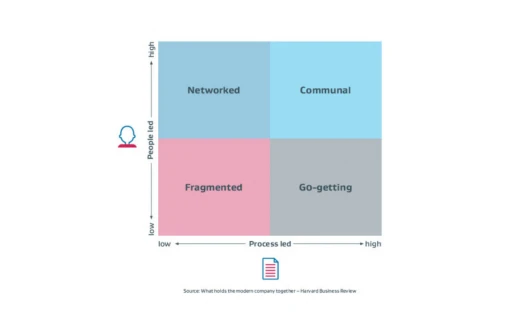

Networked – high people, low process
A networked culture works well when employees rely on one other and during difficult times.
Pros:
- constant discussion is good for teamwork and generating ideas.
- people are prepared to put up with frustrations and to support their colleagues and friends.
- people are more likely to face and solve major problems without being asked.
- ideas flow as people are less likely to feel worried about saying the wrong thing.
- because people feel a sense of belonging, they’re less likely to want to leave.
Cons:
- networked cultures can become political and exclusive, making it difficult for new people to feel they belong.
- people can end up on projects through friendship, not merit.
- because people don’t want to hurt each other’s feelings, they may not give constructive feedback and poor performance can go unnoticed.
- people may not follow process, relying on friendship instead.
- if someone does leave, others often follow.
Communal – high people, high process
A communal culture works well when:
- you need people to work towards a singular, shared goal
- it’s important to share information and have cross-functional teams.
Pros:
- people live and breathe the company mission.
- people support each other.
- teamwork thrives.
- turnover is usually very low.
Cons:
- this culture needs a strong leader.
- it’s hard to focus on people and process equally, so it can be hard to sustain.
- when people are too similar, they may not take initiative or think for themselves.
- if one employee leaves, others may follow.
- it can be difficult to integrate new employees and implement change.
Fragmented – low people, low process
A fragmented culture can work when:
- people can work on their own and want to keep their home lives separate
- people are motivated and skilled and need little supervision
- there isn’t a lot to be learned from each other.
Go-getting – low people, high process
A go-getting culture works well when you’re in a competitive industry, especially if the industry is fast paced and revenue hard to come by.
Pros:
- people will get behind your company goals if they stand to benefit.
- people know if they perform well, they’ll get what they deserve. This builds trust and can be very motivating.
- people who underperform will expect to be taken to task.
- people can still work well together despite personal differences.
Cons:
- people may avoid doing tasks that don’t have a personal reward.
- because people are highly competitive, they may be reluctant to share information and be territorial about their jobs. This makes it harder to be creative.
- it can escalate to very high competition.
- established workers are unlikely to help new workers come on board unless it benefits them personally.
Making changes
Your culture may need to change over time. This can take a while, but there are ways to focus more on people or process.
To be more people-focused:
- recruit people who are likely to develop friendships
- arrange get-togethers inside and outside work
- arrange your workspace so it’s easier to mingle
- relax your dress code so people feel more sociable and relaxed
- don’t have too many managers
- share the same workspace as your staff
- model being kind and generous.
To be more process-driven:
- create a sense of urgency
- have regular briefings on what’s happening with the competition
- encourage the will to win
- promote shared goals – create a sense of one company and one vision.
Ask cultural champions to positively influence the team. For example, if an employee is good at putting customers at ease, team them with someone who is more awkward. If someone is safety conscious, pair them with people more likely to take risks.
Build a culture that supports your business goals
- Step01
List your business goals for the next 2–5 years.
- Step02
Think about what you need to change about your business to achieve them.
- Step03
Consider your existing culture and what you value.
- Step04
Decide which culture best supports your goals.
- Step05
List the steps you could take to move towards this kind of culture.
Learn more about