Before you start
Before you start to create your logo and slogan for your brand, consider creating customer personas.
Personas are fictional profiles of the types of customers most likely to buy your products or services.
Think about who is most likely to benefit from your products or services and turn these fictional customers into personas. This involves creating a profile for each persona, including:
- what they are like – for example, name, age, personality, work and life pattern
- what they might think about your product or service
- problems your product or service wants to solve
- how and where you might best attract their interest.
Creating personas will help your brand reflect your market position, what you know about your customers, and the look and feel of your logo and slogan.
Design a logo
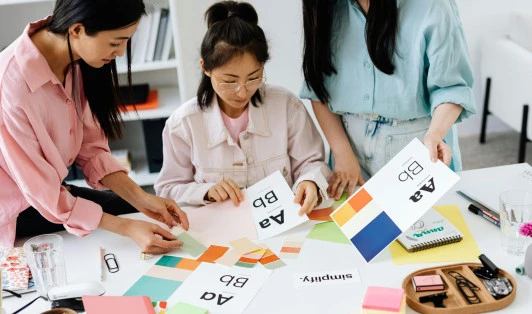
Use a professional designer to design your logo, and a brand advisor if you have one.
Your logo should be:
- eye-catching
- simple
- easy to remember
- a clue to what you do
- flexible – it could be used for signage, stationery and advertising material.
Before you design a logo:
- look for logos you like, both online and around you, and keep them in one place – for example on Pinterest, or stick pictures on a wall
- note why you like each one
- draft ideas for your own logo.
Think about colours you associate with your brand and why. Incorporating a colour into your logo can make your brand stand out from your competition.
Consider a slogan
A slogan is a catchy phrase that goes with your logo. It’s an essential part of your brand.
Think about famous brands like Nike or Tui beer, and you’ll probably hear the slogan that goes with them.
Your slogan should:
- be catchy
- be simple
- tell people what you do.
Have fun creating your slogan. Include friends and business partners. Consider getting help from a branding expert too.
Keeping branding simple

Manu takes a clear, consistent approach to gardening, focusing on a few reliable services. His brand ‘Manu’s Mowing’ reflects simplicity, trust and value for money. A bold double M logo and matching van plates reinforce his identity, making his brand memorable and professional.
Brand identity matrix
Studying your brand in more detail helps you understand it better. Use a brand identity matrix to look at different aspects of your business. Answer the questions, then look at how they relate to each other and if they fit well together.
Internal questions
- Mission and vision – what engages us (mission)? What is our direction and inspiration (vision)?
- Culture – what are our attitudes? How do we work and behave?
- Competences – what are we particularly good at?
External questions
- Value proposition – how do our key offerings appeal to our customers and partners?
- Relationships – how should we relate to key customers and partners?
- Position – what’s our intended position in the market?
Internal/external questions
- Expression – what’s distinctive about the way we communicate?
- Brand core – what core values sum up our brand?
- Personality – which human characteristics or qualities form our business character?
Purchase and usage brands
Purchase brands
Purchase brands are brands that just focus on making a sale. Once the sale is complete, their interaction with the customer ends.
For example, a coffee cart might use a branded flag to encourage passers-by to choose it over its competitors.
Usage brands
Usage brands are brands that want to build long-term relationships with customers who use their product or service.
For example, a store selling espresso machines might:
- host classes on making the perfect coffee
- share tips and tricks on social media
- give free branded T-shirts to loyal customers.
Their customers may then act like unofficial brand advocates.
Some brands link themselves to a culture their customers belong to or find appealing. Fitting in with this culture may help attract customers.
For example, the espresso machine store might:
- use and sell coffee beans roasted by a popular café
- match its décor to this café
- service the café’s espresso machine.
Learn more about