This content has been developed in association with the Institute of Organisational Psychology.
Video
Look after yourself physically Me tiaki ā-tinana i a koe anō

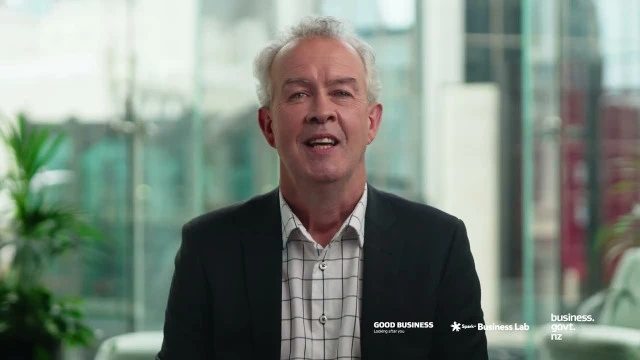
Looking after your physical and mental health can help your business to succeed. Psychologist John Eatwell discusses sleep, exercise and eating well and their impact on your headspace for success.
Transcript
Video transcript: Learn how to look after yourself physically
[Visual: Blue screen intro with white text saying: “Brave in business e-learning series headspace”.]
[Audio/Visual: As the screen opens, quiet music plays in the background. The music plays throughout the video. The screen opens displaying the title “Looking after yourself physically”. Beneath the title is sub-title text: a by-line “Good business looking after you” and the Spark Business Lab and business.govt.nz logos.]
[Visual: Screen changes to show the presenter in the centre of screen. On the bottom left of the screen, in white text on a blue background, is the speaker’s name: John Eatwell. On the bottom right of the screen in white text is the by-line “Good business looking after you”, the Spark Business Lab logo and business.govt.nz logo. The by-line and logos remain in place for the entire video.]
[The presenter, John Eatwell speaks.]
Looking after yourself is always important, especially if you’re working in a small business or if you’re the only one in the business. When you’re in a good headspace, you’re more productive, happier and less likely to burn out or get sick. In a previous video, “Looking after yourself is good for business”, we explained what it means to be in a good headspace and how that helps your business, others and you.
Let’s dive into three areas that are important for good health: sleep, exercise and eating well. We’ll talk about a few things that you can improve in each area. If you can do several things at once, great! But if you can only work on one thing, then work on one thing. The main thing is getting started.
[Audio/Visual: Text appears on screen that says, “Sleep well” with the music becoming slightly louder for 2 seconds”.]
[Visual: Screen returns to show the speaker.]
Sleep is vital for your body to recover physically and mentally. If you get enough sleep, you think better, plan better and get more done. You feel happier too. People who don’t get enough sleep feel lonelier. Those around them feel lonelier too, even if they themselves get enough sleep.
Aim for three things for good sleep: enough sleep, a regular bedtime, and enough darkness and sunlight. Let’s talk more about each of these things.
Enough sleep for most people is about eight hours: about nine in winter and seven in summer.
The second thing about sleep is being regular. Your first four hours of sleep are deep sleep, when your body repairs itself, recovers, and gets rid of waste material that your brain produces during the day. After deep sleep, you go into REM sleep, which stands for rapid-eye movement sleep. REM sleep seems to be essential for things like memory, learning, and creativity.
If you don’t get enough REM sleep one night, the next night your brain tries to catch up by prioritising REM sleep over deep sleep. If you go to bed later than usual, you’ll get less deep sleep. That’s not good because your body needs deep sleep to repair itself. Your immune system is the most active during deep sleep.
The third thing about sleep is getting enough sunlight and darkness. You need both to produce melatonin. Melatonin doesn’t help you fall asleep, but it helps you sleep well and wake up refreshed.
To get the sunlight you need, get outdoors for half an hour during the day.
To get the darkness you need, turn off your devices an hour and a half before bedtime. “Devices” means things like smart phones, tablets, laptops and computers. Also turn off any blue light in your bedroom. This means devices, and fluorescent and LED lights.
If you have trouble falling asleep, try these things.
Make sure your room and your body aren’t too hot. Your body prepares for sleep by cooling down about two hours before you normally go to bed, and this makes you feel tired. Don’t exercise hard within five hours of bedtime because that increases your body temperature. An after-dinner stroll is OK.
Stop work about an hour and a half before bedtime to give your brain a break. Working late keeps your brain active.
Try to deal with your thoughts before bedtime if you tend to lie awake thinking or worrying. For example, write your to-do list for the next day. Or write down three things you’re grateful for, to help you focus on what's positive as you fall asleep.
Avoid caffeinated drinks from mid-afternoon, because your body takes 8 to 13 hours to get rid of caffeine.
Finally, avoid alcohol late at night. Drinking late will wake you up in the middle of the night.
[Audio/Visual: Text appears on screen that says, “Exercise” with the music becoming slightly louder for 2 seconds.]
[Visual: Screen returns to show the speaker.]
The second area we’ll touch on today is exercise. You don’t have to do lots! Studies show that exercising hard for more than half an hour a day has no extra benefit.
Do some low-level exercise every day, like walking or yoga. But three times a week, for 20 minutes each time, do something harder that increases your heart rate more, like walking faster, running or going to the gym. “Going hard” improves job performance, reduces stress and produces the chemicals your body needs to make you feel happy.
Do some lifting as well, to reduce anxiety and improve brain health. “Lifting” doesn’t mean you must go to the gym. You could carry your shopping bags out to the car instead of using a trolley, or you could lift some boxes that aren’t too heavy. Aim for a couple of times a week.
[Audio/Visual: Text appears on screen that says, “Eating well” with the music becoming slightly louder for 2 seconds.]
[Visual: Screen returns to show the speaker.]
Let’s move on to eating well. The less processed your food is, the better. Eat whole foods such as:
- lots of fruit and veges
- whole grain breads and cereals
- beans, nuts and seeds
- eggs and dairy
- fish and meat.
Try to limit highly processed foods, refined sugar, salt and alcohol.
Scientists aren’t sure how food affects our mental health, but they’re sure it does. Some psychiatrists call the gut the second brain.
Bacteria in your gut produces things that your body needs, like vitamins, amino acids and happy chemicals. When you eat more whole foods, your body produces much more of the bacteria that supports your mental health.
Remember to drink enough water. You don’t need to drink a specific amount, but if your urine is yellow, it’s a sign you need to drink more. Even mild dehydration over a short period affects thinking and mood.
So those are the main areas to work on to improve your physical health:
- sleep well, and sleep enough
- get some exercise, and
- eat well.
What will you do today to improve in one or more of those areas? Download our tips for sleeping well, and a simple file to record how you’re sleeping, eating, and exercising.
Do the check-in on this page too, to see what you know about looking after yourself and to get more tips.
[Audio/Visual: Display changes to closing screen, displaying the Spark Business Lab logo and business.govt.nz logo in the centre of the screen, the same music plays in the background.]
[Video ends]