
This content has been developed in association with the Institute of Organisational Psychology.
How to prioritise
At the end of your week, you’ll use the same method to think about what you’ve done.
Reviewing helps you understand where you’ve spent your time and prioritise better in future.
For example, if you’ve been too ambitious, you can plan fewer tasks next week.
If you had many unexpected things, come up, you can allow more time for surprises next week.
Try not to plan more than 80 per cent of your time, so you have time for unexpected tasks. If you work an 8-hour day, prioritise no more than 6.5 hours if you can.
Method 1: What are your goals for this week?
Identify your goals for the week. Decide on three quick questions to ask yourself, so you’re clear about what’s important. For example:
- What do I need to finish this week?
- What is my focus this morning?
- What do I need to do by the end of Wednesday to make sure that I’m on track?
Then refer to your answers during the week as you prioritise your tasks. If a task helps you achieve your goals, do it. If it doesn’t, consider delaying it or asking someone else to do it.
This quick method will suit you if you feel you don’t have time to think. If you like, you could answer the questions as you get ready for work on Monday morning.
| Goal 1 | |
| Goal 2 | |
| Goal 3 |
Method 2: What’s urgent? What’s important?
Use this method to prioritise based on urgency and importance. This method is often associated with former US President Eisenhower.
Create a quadrant, with headings in each of the squares.
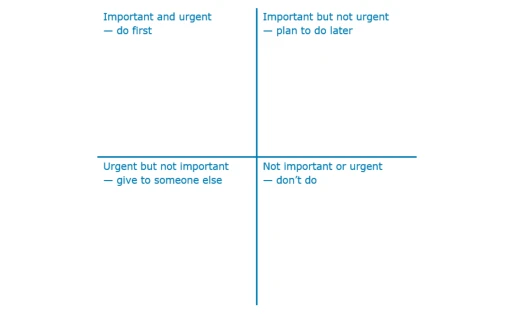
Top left quarter - Important and urgent
Do these first. These are the things that will cause serious problems if you don’t do them immediately. These will probably be the things that are stressing you out most. Examples are tomorrow’s deadline and urgent requests from your best customer.
Top right quarter – Important but not urgent
These things are important for long-term success but don’t need to be done yet. Examples are working on your business strategy and doing professional development.
Try to spend most of your time on these tasks.
Bottom left quarter - Urgent but not important
Give these to someone else. Things that need to be done, but not necessarily by you. Examples are organising a meeting and upgrading your server.
Bottom right quarter – Not important or urgent
These things can be left off your to-do list. These things are important for long-term success but don’t need to be done yet. Examples are working on your business strategy and doing professional development.
Try to spend most of your time on these tasks.
Method 3: What gives you the most reward for your effort?
Use this method to prioritise based on reward and effort. This method works for tasks and projects.
Create a quadrant, with headings in each of the squares.
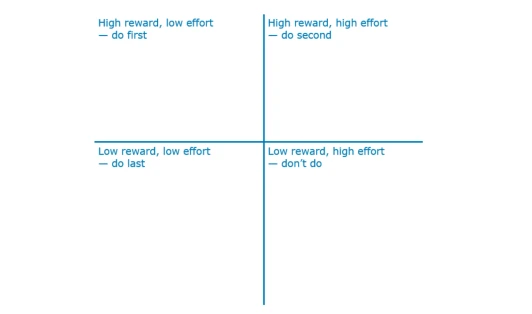
Top left quarter – High reward, low effort
Do these things first. Things that offer a high reward and are quick and easy to do, like calling a potential new customer.
Top right quarter – High reward, high effort
Do second. Things that offer a high reward but will take a lot of work, like developing a new product.
Bottom left quarter – Low reward, low effort
Do these things last. Things that don’t offer much reward but are quick and easy to do, like signing up for a newsletter that you’re unlikely to read.
Bottom right quarter – Low reward, high effort
Don’t do things that don’t offer much reward and will be time-consuming and hard, like doing extensive research on a non-critical decision.