
Before you start ask yourself these questions
Do I have what it takes?
Running a business can challenge your resilience.
It helps if you are:
- passionate – if not, you’ll find it hard to keep going when things get hard
- prepared to make changes – you might have less money and time to spend on hobbies and with friends and family, at least as you’re starting out
- good at managing risk – it may take time to develop a steady flow of revenue
- persistent – things may not always go to plan.
- open to learning new skills – you may have multiple responsibilities until you hire staff or advisors.
How good is my business idea?
There can be big differences between a good idea and an idea that will be strong enough to build a business from. Often the most commercially successful ideas are the simple ones, like identifying a gap in the market that can be filled with a new product or service.
Take time to assess your business idea before you leave your job, borrow money, or make big changes to your life.
Will I solve a problem or fill a need?
If your idea for a business is not going to solve a problem or meet an unfulfilled need for the public or another business, start again.
If it is, think about the scale of this problem or need. If it’s minor, you might struggle to make sales.
This is a key aspect of business planning. Draft a basic business plan to help test whether you have a viable idea.
Will people buy from me?
Unique selling point
Unless you’re going to sell something no one has thought of before, you’ll be competing against other businesses. Your products or services must stand out from the rest.
Develop your unique selling point
Customer profiles
It’s useful to create personas as you shape up your idea. Think about where you can find your ideal customers, what they value, what they’re worried about and what they need.
Pricing
Find out what your competitors charge for the same or similar products or services and how much customers are prepared to pay for yours. You should also check if there are industry-standard prices for your type of service or product.
It’s also good to think about the optics of your pricing too:
- If you charge less than your competitors, could your product or service be seen as inferior?
- If you charge more, can you justify this by offering better quality products, or superior service?
Numbers game
Figure out how much you’ll have to earn to cover the cost of sales and your monthly overheads. Have realistic estimates of future income and costs to work out when you’ll be in profit. If the numbers show you won’t make profits for some time, see if you have funds to support you.
How much will it cost to start up?
Once you have a basic plan and know your numbers, you need to figure out how much money you’ll need to start your business.
Who are my rivals?
Some markets are harder to get into than others.
Ask yourself:
- how many competitors you’ll have
- if any of them will be in direct competition with you
- how difficult it will be for others to replicate your product or service
- how you can differ from my competition.
Will I sell overseas?
If your business is successful, you might consider selling your products and services overseas.
Exporting has advantages, including:
- growth – the rest of the world offers a much bigger market
- economies of scale – cost per unit often drops when you make more units.
- managing seasonal fluctuations – exporting may help to even out seasonal changes in demand for your product
- spreading risk – selling to more markets means you won’t have all your resources in the New Zealand market.
Watch: Turning your side hustle into a business
Transcript
Video transcript: Turning your side hustle into a business
[Audio/Visual: Upbeat music starts playing as a blue introduction screen opens and the white text “business.govt.nz presents” is displayed in the centre of the screen. The music plays throughout the video.]
[Visual: The text changes on the blue screen to “Turning your side hustle into a business” displayed in white text in the centre of the screen. The screen changes to show the presenter in an office space in the centre of the screen.]
Think you've got a great idea for a business, but not quite sure how to bring it to life? There are so many things to think about and do,
[Visual: The black text “business.govt.nz” appears in a white button at the bottom of the screen and stays in place. A mouse icon hovers over the screen and clicks on the button and disappears from screen.]
but business.govt.nz has a range of resources to make it easy.
[Visual: The text “business.govt.nz” in a white button disappears from screen.]
First up, how solid is that idea really? To figure out whether your concept is going to fly, a business plan is a good start.
[Visual: The screen changes to show a person at a work bench using a tool to make a ring. The screen changes to show a close-up of the worker’s hands and the ring. The screen changes to show a worker at a work desk with a sewing machine and fabric. The screen changes to show a close-up of fabric dog scarves hanging on a wall in a store. The screen changes to show a close-up of a dog sitting on a store floor, wearing one of the scarves. The screen changes to show a counter in a café and two workers. The screen changes to show a close-up of a salad product in cardboard takeaway boxes. The screen changes to show a selection of food in a food cabinet.]
This will firm up your thoughts about what your business offer is, who your customers will be, how your product or service will stack up against the competition, what your goals are, and how you plan to reach them.
[Visual: The screen changes to show the presenter in the centre of the screen.]
If you need finance from a bank or investors, they will expect you to have a business plan. But even if you don't, a plan is a good way to clarify your thoughts about your business, test it out, and build a business that suits you and your lifestyle.
[Visual: The black text “business.govt.nz” appears in a white button at the bottom of the screen and stays in place. A mouse icon hovers over the screen and clicks on the button and disappears from screen.]
What's more, the business.govt.nz website provides plenty of tips and free templates to help you get your plan done.
[Visual: The text “business.govt.nz” in a white button disappears from screen. The screen changes to show the business.govt.nz website homepage and a mouse icon click on the menu. The screen changes to show the contents of the menu and a mouse icon click on “Getting started” and then on “Business planning tools and tips”.]
You can find them by clicking on the menu icon and looking under Getting started, Business planning tools and tips.
[Visual: The screen changes to show the presenter in the centre of the screen.]
Writing your business plan will help you make other big decisions more easily. Case in point, choosing a business name, for example. Your business idea may have started with a single product or service, but as you write your business plan, you see scope for expansion into other products or services later. This may steer you towards a name that reflects that larger goal or a quality that the products or services share, rather than one tightly focused on the startup idea.
[Visual: The screen changes to show the business.govt.nz webpage “Choosing a business name”. The screen changes to scroll down the webpage to the section “How to choose a name”.]
If you're stuck, there are tips for choosing a business name on the business.govt.nz website.
[Visual: The screen changes to show the presenter in the centre of the screen.]
Whatever you decide on, even if it's your own name, you need to be sure that your business name is not being used by anyone else.
[Visual: The white ONECheck logo appears in the top right-hand of the screen and disappears after a few seconds.]
This is where the free One Check tool can save you a lot of time and hassle.
[Visual: The black text “business.govt.nz/onecheck” appears in a white button at the bottom of the screen and stays in place. A mouse icon hovers over the screen and clicks on the button. The screen changes to show the ONECheck tool start screen and the name suggestion “Earls Electrical” being typed into the search bar. The screen changes to show the search results for “Earls Electrical”.]
Simply head to business.govt.nz/onecheck. Enter the name you want to use in the search bar, and the tool will tell you if it is available to use as a business name, website address, and social media username.
[Visual: The screen changes to show the presenter in the centre of the screen.]
You can repeat your search easily testing name options until you find one that's not taken and that works for you and your business.
[Visual: The screen changes to show the “Registering your business name” pop-up in the ONECheck search results. The screen changes to show the New Zealand Business Number (NZBN) webpage “Applying for an NZBN”. The screen changes to show the “Registering your business name as a trade mark” pop-up in the ONECheck search results. The screen changes to show the Intellectual Property Office of New Zealand (IPONZ) webpage “Trade mark check”. The screen changes to show in-depth information on the web domain availability for the search results “earlselectrical”. The screen changes to show the Domain Name Commission NZ webpage “.nz authorised registrars”.]
Once you've found it, you can follow links to do other tasks like getting a NZ business number, applying for a trademark, or purchasing a web domain.
[Visual: The screen changes to show the presenter in the centre of the screen.]
There is plenty of information to help you decide which of these things you need to do. Alongside these tasks, you'll need to be thinking about what structure will suit your business best.
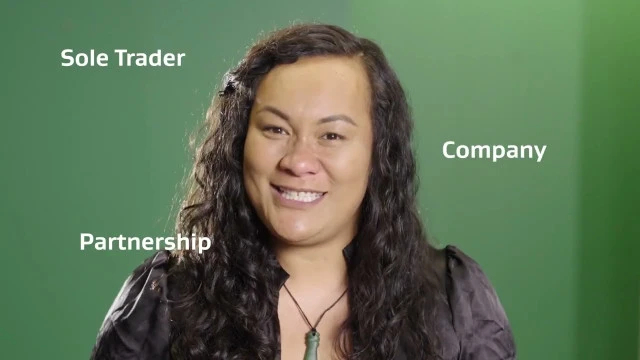
[Visual: In order, the white text “Sole Trader”, “Company” and “Partnership” appears around the presenter and disappears after a few seconds.]
The most common structures in New Zealand are sole trader, company, or partnership, and once again, there's a free online tool that can help you make the right choice.
[Visual: The black text “business.govt.nz” appears in a white button at the bottom of the screen and stays in place. A mouse icon hovers over the screen and clicks on the button. The screen changes to show the business.govt.nz website homepage and a mouse icon click on the menu. The screen changes to show the contents of the menu and a mouse icon click on “Tools and resources”. The screen changes to show the business.govt.nz webpage “Tools and resources”. The screen changes to scroll down the webpage to the tool “Choose your business structure” and click on the button to “Get started”. The screen changes to show the Choose Business Structure tool start screen. A mouse icon clicks through the three yes-no questions of the tool and clicks the “View your result” button. The screen changes to show the results page for “Sole trader”.]
It's called the Choose Business Structure Tool, and you can find it by going to the business.govt.nz website and looking under Tools and resources.
[Visual: The screen changes to show the presenter in the centre of the screen.]
Based on your answers to three simple questions, which you will probably have thought about when writing your business plan, the tool will say whether being a sole trader, a company, or a partnership is the best structure for you and allow you to compare the suggestion to the other options.
[Visual: The screen changes to show the results page for “Sole trader” in the Choose Business Structure tool. The screen changes to scroll down the results page and click on the button “Learn more about Sole trader”. The screen changes to show the results for “Sole trader” in more detail. The screen changes to scroll down the results page.]
It gives you information about your recommended structure, its benefits, important considerations like legal, tax, and financial obligations, and goes through what you need to do to set it up, run it, and close it down with guidance around any associated costs.
[Visual: The screen changes to show the presenter in the centre of the screen.]
Depending on your business, there may be other things you need to think about like complying with privacy or health and safety legislation, or you may need to get a licence for certain industries. Plus there's tax and other financial matters.
[Visual: The black text “business.govt.nz” appears in a white button at the bottom of the screen and stays in place. A mouse icon hovers over the screen and clicks on the button. The screen changes to show the Compliance Matters tool start screen.]
And yes, business.govt.nz has a tool to help with that too.
[Visual: A mouse icon selects the option “Tax and levies” from the drop down “What subject do you want to know more about?”. The screen changes to show the filtered results page. A mouse icon hovers over the topics “Annual returns”, “Tax & employer registration”, “Paying tax and ACC levies”, “GST”, “Resident withholding tax” and “KiwiSaver”.
The Compliance Matters database allows you to search various topics and see what the requirements are for your industry sector and business structure.
[Visual: The screen changes to show the presenter in the centre of the screen. The screen changes to show the business.govt.nz webpage “Tools and resources” with a close-up on the “Ten steps to start a business” and “Start up Business plan” tiles. A mouse icon hovers over the screen and clicks on the button “Check it out” on the “Ten steps to start a business” tile. The screen changes to show the business.govt.nz webpage “Guide to starting a business.” The screen changes to scroll down the webpage.]
A great place to access all these tools and resources is business.govt.nz's online 10 step guide to starting a business. That may be where you have found this video.
[Visual: The screen changes to show the presenter in the centre of the screen. The screen changes to show the business.govt.nz website homepage and a mouse icon click on the menu. The screen changes to show the contents of the menu and a mouse icon click on “Getting started” and then on “Taking the first steps”.]
But if not, go to business.govt.nz, click on the menu icon and look under Getting started, Taking the first steps.
[Visual: The screen changes to show the presenter in the centre of the screen.]
So don't let overwhelm get in the way of your great idea.
[Visual: The black text “business.govt.nz” appears in a white button at the bottom of the screen and stays in place. A mouse icon hovers over the screen and clicks on the button and disappears from screen.]
Head to business.govt.nz and start your business journey on the right foot.
[Visual: The text “business.govt.nz” in a white button disappears from screen. The screen changes to the full blue outro screen. The upbeat music swells as the business.govt.nz logo lifts into the centre of the screen before fading out. The Ministry of Business, Innovation & Employment, Hīkina Whakatutuki logo and the New Zealand Government, Te Kāwanatanga o Aotearoa logos then fade into view on either side of each other.]
[Video ends]
Defining your business
Before you start researching your market, define what your business does and if it’s unique.
Then, ask yourself:
- why customers would buy your product or service
- if there’s a demand for it
- what else is on offer in the market
- Your answers are the basis of your research into your market and competition.
The results can also be useful to show potential investors or financial institutions you’re a good business to invest in.
Researching your market
Think about your customers. They could be:
- other businesses (business-to-business or B2B)
- members of the public (business-to-consumer or B2C).
Knowing who will buy your products or services and why is essential for your planning. This applies to domestic and overseas markets.
You should:
- make sure what you’re selling appeals to your target customers
- find out how large your potential market is
- find out where your customer market is.
Statistics New Zealand’s data for business can help you with this.
What market information is available can depend on the industry you’re in.
Banks also produce research you can access freely, but it’s often general information about the economy and small businesses.
Researching your competitors
Find out what advantages competitors have over the business you’re planning and analyse their pricing and marketing strategies.
Try to find out:
- who your competitors are
- their sales figures
- where they’re based
- what portion of your market share they already serve.
Paying for research
If you can’t find the data you’re after for free, you can pay for more detailed research from Statistics New Zealand’s Customised data services, or independent research organisations such as the New Zealand Institute of Economic Research and Research New Zealand.
Learn more about