
Capacity helps many aspects of your business
Getting your capacity right can help you in several ways:
- Sales – you’re ready for your customers whenever they’re ready to buy your products or services.
- Costs – you avoid spending money on resources you don’t need.
- Cash flow – you don’t tie up money in excess stock if you don’t need to.
- Quality – you can meet your customers’ needs without compromising on the things they find valuable.
- Speed of service – your customers don’t have to wait.
- Reliability – you don’t have to turn customers away or disappoint them.
- Flexibility – you’re ready to respond to sudden spikes in demand if necessary.
Measure current demand
- Step01
Choose an aspect of your business that shows how much demand there is
For example, number of items you sell, number of customers you serve, or number of work requests you receive.
- Step02
Choose the most logical period of time to measure
For example, a standard work week, the busiest period of each day, or your busiest season.
- Step03
Match up these two things
For example:
- number of items you sell each week
- number of customers you serve between 8am and 10am each day
- number of work requests you receive in June, July, and August.
Analyse your data
Look at historical data such as sales figures or bank transactions. Check things like:
- how much business you’re doing in the time period you’re looking at
- if you can spot any trends.
For example, you might usually sell a certain number of items a week, but your sales figures show an increase in March and April that you hadn’t noticed before.
Looking across 12 months helps you spot longer-term trends, while looking at shorter time periods helps you see the detail of seasonal events – such as summer or Christmas.
Talk to your customers and suppliers
Gathering data and opinions from people involved with your business gives you great insights. Customers and suppliers can tell you all sorts of things you can’t see yourself or haven’t considered.
Ask customers what they like, what they don’t like, and what you could change to serve them better. Consider offering a small reward or a prize draw for taking part.
You can gather your customers’ opinions in many ways, like setting up an online survey or asking for feedback at your point of sale.
Ask suppliers their thoughts on what’s happening in your industry. For example, if they’ve spotted trends you should be aware of or noticed anything that similar businesses are doing, that you should be doing too.
Predict future demand
Demand doesn’t always stay constant. As well as measuring current demand, you should consider possible increases or decreases in demand.
Ask yourself:
- Is your business growing?
- Is you customer base expanding?
- Are new competitors entering the market?
Think about the wide range of factors that might affect demand in the future, such as the following:
- Political factors – for example, a change of government might affect consumer confidence.
- Economic factors – for example, the changing price of ingredients might affect how much you can charge for your products.
- Social factors – for example, your core customers might be growing older and having children.
- Behavioural factors – for example, your customers might want more eco-friendly products or packaging.
- Environmental and climactic factors – for example, warmer or colder weather might affect what people will and won’t buy.
- Festival or cultural factors – for example, increasing interest in certain celebrations, such as Matariki, might create new sales opportunities.
- Technological factors – for example, creating a new website, app, or social media channel might make your products or services easier to access.
- Legal factors – for example, new regulations might bring in certification for your product, meaning customers can easily see your superior quality.
Measure capacity
To measure capacity, you can focus on either inputs or outputs. Inputs are the resources you put into your business, such as staff hours and raw materials. Outputs are the products or services you provide to your customers.
If you just make a single, standard product, it’s relatively easy to measure your capacity for that output. The greater the range and variation of your outputs, the harder it becomes to measure capacity. In this case, it might be better to focus on inputs – for example, the maximum number of hours your staff are available each week to make products or provide services. Only measure the inputs and outputs that make sense for your business.
Input or output measures for different business types
| Type of business | Input measures of capacity | Output measures of capacity |
| Craft brewery | Amount of ingredients Volume of vats to brew beer Length of time to brew a vat of beer |
Bottles of beer produced each week |
| Plumbing business | Number of hours any master plumbers can work each week Number of hours any apprentice plumbers can work each week Number of jobs that can happen at the same time |
Billable hours each week Amount of downtime each week (for example, rain days, travel time, holidays) |
| Café | Number of seats Number of wait staff Number of meals the chef can prepare at once |
How long seats are occupied for Customers served each lunchtime Meals served each day |

Match capacity to demand
Once you’ve measured demand and capacity, it’s time to make changes. Remember, you’re aiming for a balance between making the most of sales opportunities, keeping your customers happy, and keeping costs down.
Ask yourself:
- How are you doing so far?
- Are you always under pressure to serve your customers?
- Could you easily do more business than you’re currently doing?
- What about if demand changes in the future?
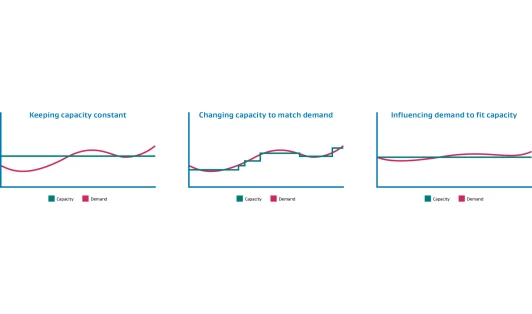
Approaches to capacity
Keep capacity constant
If customer demand for your business is mostly constant, you may be able to keep capacity constant and absorb any slight increases in demand.
For example, you might be happy letting people queue, or you might take pre-orders and let people know there’s a waiting time. Making customers wait isn’t always a bad thing – it may even show that your business is popular and worth waiting for. For example, a sushi shop that regularly has a queue outside at lunchtime could quickly get a reputation as the best sushi place in town.
Another way to keep capacity constant is to use quieter times to prepare for busier times – for example, by stockpiling inventory. Of course, this only makes sense if you’re sure there’ll be the same demand later. If you’re selling clothes, there’s no point stocking up on what’s selling well right now if customers will want a different fashion next month.
Change capacity to match demand
To match changing customer demand, you may need to increase or decrease capacity. You could roster staff on for extra shifts when it’s busy or ask them to take their holidays when it’s quiet. You could also hire contracts or subcontract in peak periods or outsource if necessary.
To make this method work for you, you need to regularly re-assess customer demand and make sure you’re responding to it accurately. Also, consider the potential downsides. For example, the cost of recruiting and training new staff if you only need them for short periods, and loss of control over quality if outsourcing.
Influence demand to fit capacity
Influencing the behaviour or expectations of your customers can increase or decrease demand for what you’re selling. You can:
- increase demand by cutting prices (having a sale)
- reduce demand by increasing prices at busy times (peak fares or surge pricing)
- shift demand from one thing to another by offering attractive alternatives – for example, if a restaurant reaches capacity for serving steak because of a backlog, wait staff can tell customers there’s a special on other dishes.
If you have distinct busy and quiet seasons, you could market the same thing in a different way to make off-season more attractive (like hotels offering off-peak holiday packages).
You might even consider developing new products or services to fill periods of low demand. For example, a food cart selling homemade ice cream and fruit juice in summer could start selling homemade soup and hot chocolate in winter.
Influencing customer demand

After measuring demand and capacity, Aroha figured she could sell more lunches between 12pm and 2pm if she had more staff, if meals took less time to prepare, or if more customers chose bagels over the big brunch. She now considers how to tweak capacity to better meet demand.
Benefit of flexible capacity
Some businesses benefit from flexible capacity – the ability to quickly respond to changing or unpredictable demand.
For example, you might need to quickly and easily:
- change the volume or range of things you make or offer
- change from making or offering one thing to making or offering another.
Doing one thing and doing it well tends to cost less than trying to do a wider range of thing – or frequently changing what you do.
Ways to stay flexible
Define the type of flexibility your business needs
Whether you need flexibility, and what type you might need, depends on what your customers want and what your competitors are doing. For example, you might need to respond to customer orders quickly, no matter when they come in. Or you might want to be able to quickly increase or vary what you’re doing, to create a point of difference in an ever-changing market.
Update measurements for your new processes
If you decide to become more flexible, you need to set benchmark measures before you change anything so you can measure any improvements. Flexibility can be costly and disruptive, so you want to make sure that you’re benefiting from any new processes.
Train your people
Your people are key to achieving flexible capacity. Whatever you need them to do to stay flexible will only happen if they’re on board and enthusiastic. It’s your job to train them and make sure they understand how important flexibility is to the success of the business.
Create incentives for your new processes
To make flexibility successful, consider offering your employees incentives. For example, a bonus each time they produce more than a certain amount in one day. You could also encourage and reward staff for identifying ways to make processes more efficient.
Adapt your leadership style to suit the situation
How you lead your team may need to change depending on what you need them to do. At times you may need to set the pace and expect immediate results. At other times you may need to take a step back, listen, and debrief to make sure you understand any issues.
Finding flex in production

Te runs a small t-shirt printing business. They change their printing setup whenever necessary to respond to orders. It takes a full day to do the changeover. In a busy month, they can lose a week in changeover time. Te realises how inefficient this approach is and decide to get more flexible.
Learn more about